
Cameron County City Directory Collections
The surviving runs are uneven, which makes the year label essential. Texas State Library and Archives Commission, or TSLAC, lists separate Brownsville and Harlingen holdings. Wilmot volumes add earlier local coverage, while a Southwestern Bell catalog entry supplies a telephone-directory lead for Harlingen and the Rio Grande Valley. Newspaper collections add dated notices when a directory year is absent. Start with the place and period that match the question, rather than treating these collections as one complete countywide roll.
| Collection | Years | Where Held | Access |
|---|---|---|---|
| Brownsville directories | 1966, 1968, 1970, 1971, 1973, 1978, 1978 residential, 1982 | TSLAC city-directory holdings | Reading room or other listed research routes |
| Harlingen directories | 1965, 1966, 1969, 1971, 1973, 1978 | TSLAC city-directory holdings | Reading room or other listed research routes |
| Brownsville Wilmot | 1938, 1940, 1942, 1943-44, 1946, 1948, 1951, 1953 | HABS/LOC-cited Wilmot and Hunter Collection evidence | Use the cited repository trail to locate a volume |
| Harlingen Wilmot | 1939, 1944, 1950, 1956; broader 1939-1956 run discussed | THC/NPS registration evidence | Locate by title and year |
| Southwestern Bell “Telephone directory: Harlingen, Texas and Rio Grande Valley” | 167-page catalog item | FamilySearch Library catalog, identifier 2486128 | Catalog or library access may vary |
| Brownsville and Valley Morning Star newspapers | Brownsville interface; Valley Morning Star 1901-2017, digital Jan. 1930-Aug. 1981 | Local archive and library systems | Digital and microfilm/original coverage differ |
A listed year shows that a holding or cited volume exists. It does not establish an annual run, full text online, or a result for a particular surname. Record a no-listing result as a finding, then test nearby years and a second source.
Brownsville Directory Years on Record
TSLAC identifies Brownsville holdings for 1966, 1968, 1970, 1971, 1973, 1978, a distinct 1978 residential volume, and 1982. The Wilmot evidence reaches further back, with Brownsville volumes cited for 1938, 1940, 1942, 1943-44, 1946, 1948, 1951, and 1953. Those lists are especially useful for selecting a year close to a family event or address change. They do not bridge every year between volumes.
Use the title exactly as printed in notes. A source citation preserved in a historical biography is a pointer, not a substitute for the original page. For example, a Texas State Historical Association biography reports that a 1955 Brownsville directory listed Consuelo Aldape de Vega Hidalgo and her husband Vincente Vega Hidalgo, with his occupation. Locate the directory page itself before relying on that entry.
Cameron County Directory Timeline
This short chronology identifies cited or held volumes, not a complete publication history. It helps place a name search near the period of interest while keeping gaps visible.
- 1938: Brownsville Wilmot evidence begins among the cited volumes.
- 1939: A Harlingen Wilmot directory is cited, including the Baxter Building category snapshot.
- 1965: Harlingen appears in the listed TSLAC holdings.
- 1966: Brownsville appears in the listed TSLAC holdings.
- 1978: TSLAC lists Harlingen, Brownsville, and a separate Brownsville residential volume.
- 1982: Brownsville is listed among the TSLAC holdings.
Use the exact edition and page for any conclusion. A gap between these dates may reflect a holding gap, a different repository, or an unlocated issue.
Harlingen Wilmot Directory Runs
Harlingen’s TSLAC holdings include 1965, 1966, 1969, 1971, 1973, and 1978. Earlier Wilmot City-Suburban Directory evidence cites 1939, 1944, 1950, and 1956, with a broader 1939-1956 run discussed in preservation material. These titles can provide street, business, medical-professional, apartment, or tourist-court leads. A telephone listing or business entry is still only a dated relationship to an address or institution.
Start at the nearest verified year. A missing name may reflect a skipped issue, a spelling difference, a move, a non-householder role, or an address that was listed in another part of the volume. The old street form should remain in the notes even if a current map uses another label.
Use the FamilySearch Library catalog entry for the Harlingen telephone directory as a catalog lead for the 167-page Southwestern Bell item.
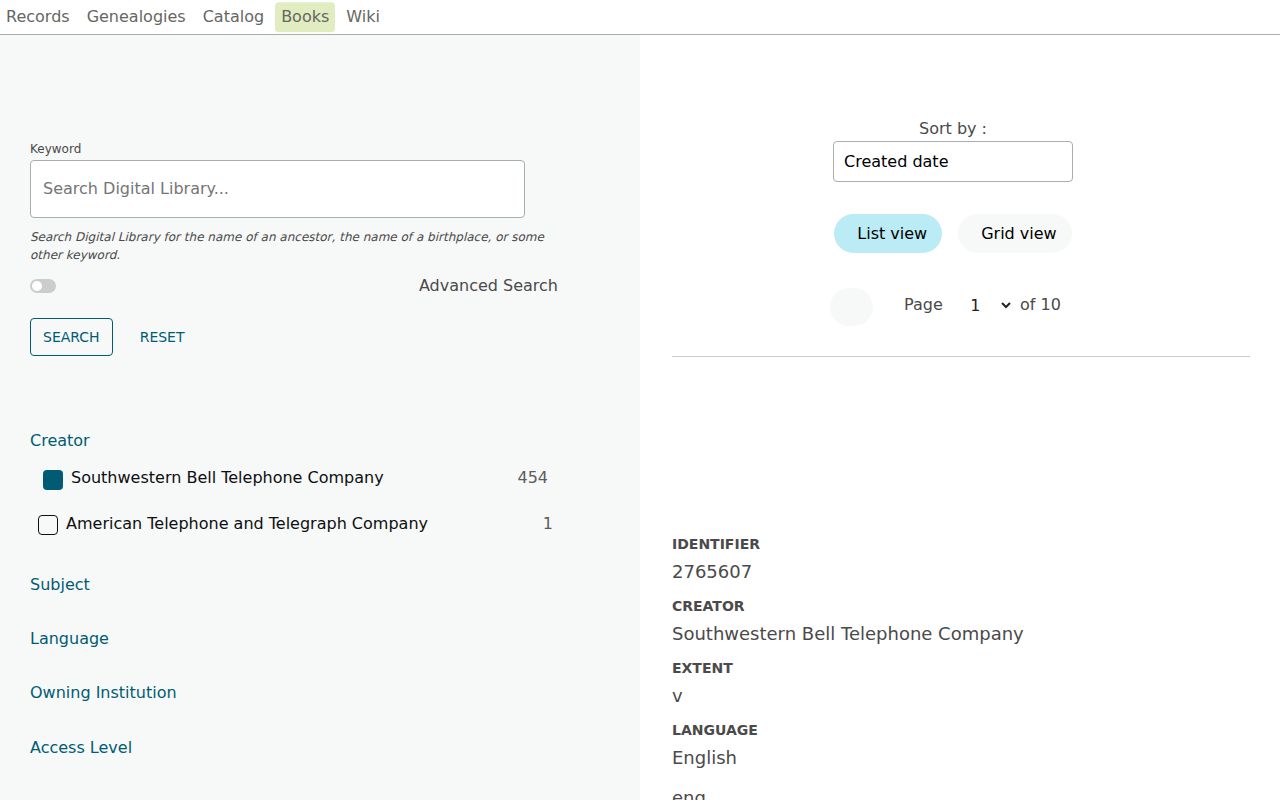
Catalog access can vary by library route, so preserve the title, catalog identifier, and the access condition in the research log.
Reading Cameron County City Directory Entries
Read an entry as a citation-sized lead, not a finished identity. The useful question is what the volume actually says on its page, including whether it is a street entry, a person entry, or a household or business label. The evidence type matters too. A directory has a different weight from a deed, newspaper notice, tax record, court item, or obituary.
| Directory title | The title printed on the volume, including the place and edition. |
|---|---|
| Publisher | The publisher named in the volume or repository record. |
| Year and page | Publication or coverage year, then the exact page consulted. |
| Street or address entry | The form of the address exactly as printed, including an old label. |
| Household or business label | Whether the page presents the result as a household or business lead. |
| Repository reference | Call number, catalog link, reel, or other locator needed to revisit the item. |
- Criss-cross directory
- A reverse section that starts with an address and leads back to a name. Check both the alphabetical and reverse or address sections where they exist.
- Householder index
- An index arranged around the household or address presentation used by that volume. It is a research lead, not proof of continuous residence.
- Abbreviation key
- The volume’s own explanation of shortened labels or marks. Capture it with the page citation because meanings can differ by publisher and edition.
Baxter Building 1939 Snapshot
The 1939 Harlingen directory provides a narrow, useful view of one downtown building: THC/NPS material reports 17 medical professionals, five insurance companies, and 18 businesses in the Baxter Building. It also placed cabins and tourist courts under “Apartments.” This is a historical category snapshot, not a roster of current people and not proof that every person named there made a permanent home in the building.
For a block-level question, pair the directory page with a dated newspaper item, a deed or plat, and a map. That combination can separate a business presence from a property interest or a household connection.
Cameron County Directory Access Routes
TSLAC cannot search whole directories by phone or send scans by email. Its Reference Reading Room has city directories and vital indexes on open shelves, while the genealogy collection is closed-stack and retrieved by staff. Public computers and databases are available on site. The research guide also points researchers toward the UNT Portal to Texas History, Ancestry Library Edition on site, HeritageQuest, WorldCat, and local or academic libraries.
Use the TSLAC Cameron County microfilm guide before planning a visit or selecting an alternate repository.
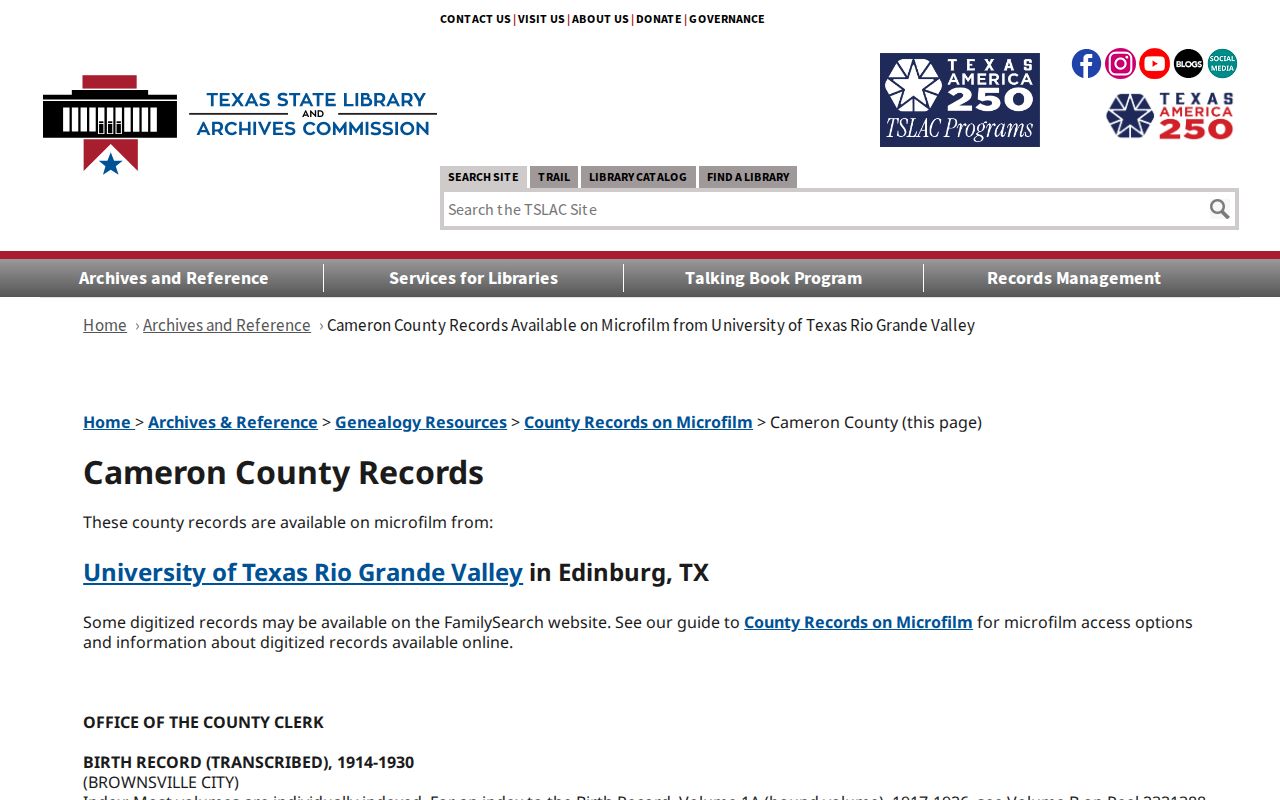
That guide also identifies birth, burial, cemetery, civil-minutes, and deed-of-trust microfilm. These are companion records for testing a directory lead, not a replacement for the volume and page citation.
UTRGV Edinburg also holds Cameron County microfilm listed by TSLAC, particularly useful for nineteenth- and early-twentieth-century birth, death, burial, civil-minutes, and deed-of-trust research. Confirm access and the reel’s date span before making a trip.
Cameron County Directory Newspaper Checks
Brownsville’s newspaper interface supports page-text terms, Boolean searching, title and place filters, and date controls. Harlingen research can use the Valley Morning Star finding aid, which covers 1901-2017, and a digital archive described as January 1930 through August 1981. Later Valley Morning Star material is represented by microfilm or originals in the finding aid.
OCR can miss a surname. Search name variants, the street, an institution, and Spanish-language forms where appropriate, then inspect the page image. Record title, date, and page. A notice may corroborate a dated connection but does not prove continuous residence.
Trace a Cameron County Household
A household trail begins with one dated address from a deed, obituary, newspaper, directory, or family material. Use a city directory to search both the person and the street. Pair a directory year with an available census year when household-level context is needed, then test the result against a primary local record. Keep the year a directory was published separate from the year a person is thought to have lived there.
- Write down the dated address, the source that supplied it, and any variant spelling.
- Find the matching city-directory year and check the alphabetical and reverse or address sections.
- Compare an adjacent held year. Do not assume an unlisted intervening year was published or survives.
- Pair the directory date with a census year or another dated local source for the household context.
- Verify the connection with a deed, tax card, voter entry, court filing, marriage or death record, or newspaper notice, then cite repository and page.
A name disappearing can mean a move, death, changed spelling, an unlisted role, or an unavailable issue. It does not by itself prove absence. Preserve each result and compare independent record families before drawing a conclusion.
Brownsville Historical Association Archives
Brownsville Historical Association holds approximately 18,000 items, including photographs, manuscripts, land grants, architectural drawings, newspapers, maps, and other paper archives. Its Portal to Texas History collection has dated material from 1911 to 1956. Research hours are listed Tuesday through Saturday, 10 to 4, at 1325 E. Washington in Brownsville; the listed contact is (956) 541-5560 and info@brownsvillehistory.org.
Browse the Brownsville Historical Association collections overview when a directory entry points to a property, business, civic event, or photograph collection.
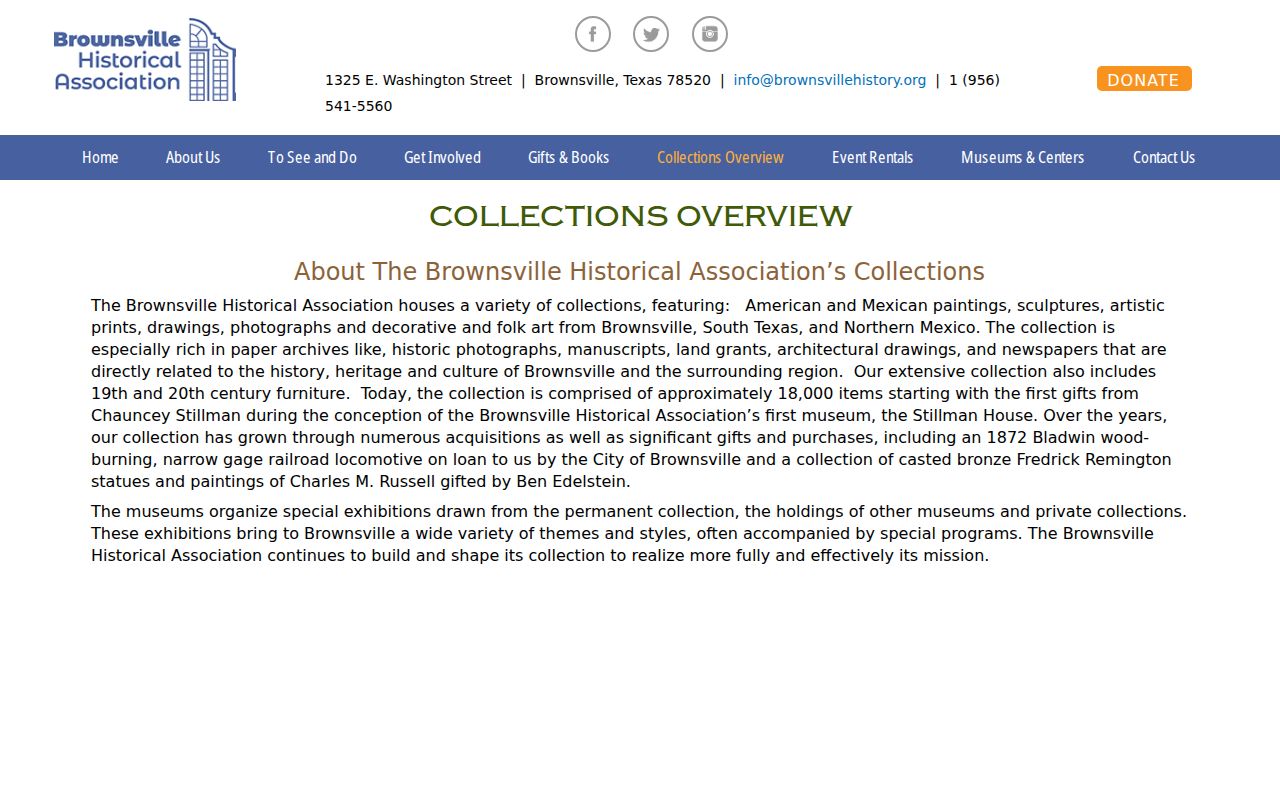
BHA also recovered 106 Chamber of Commerce boxes covering roughly 80 years. Digitization continues, so an inquiry should request a box or folder citation and confirm whether an item is processed or digitized.
Ask about appointments, reproduction rights, and whether an item is already digitized. A collection inquiry becomes useful later only when it preserves the repository, collection, box or folder, and item-level reference.