
Finding Cameron County Residents
Start with the fact already tied to a person or place. An address works well in the Cameron Appraisal District search, while a name may be better suited to the County Clerk’s recorded-instrument index or the state voter tool. A historical question often needs an older city directory, newspaper, or archival reel. Each source has a different role. A deed connects parties to a recorded transfer, a voter result is a registration clue, and a directory is dated published evidence. None of those sources alone proves that a person lived continuously at an address.
For a current Cameron County residents directory search, keep a simple record of the source, date, person’s role, and link. Compare two independent record families before treating a result as a match. That can mean a CAD parcel label plus a recorded deed, or a directory listing plus a newspaper notice. Common surnames, Spanish naming order, initials, and former names make the second check important.
- Search an address or owner name in the Cameron CAD property portal and note the PID, GEO ID, situs address, and legal description.
- Check the County Clerk’s current index for a grantee, grantor, document date, recording number, or subdivision description.
- Use the VoteTexas lookup only to confirm a registration or polling-place lead, adding the county and other requested fields only when needed.
- For an older household, compare a city directory or newspaper date with a deed, tax, vital, or archival record.
- Ask the custodian for an existing record when the needed series is not online, rather than assuming that no result means no record.
Note: Record a result as owner, party, registrant, listed household, or unknown, because those labels answer different questions about Cameron County residents.
Cameron County Resident Records Offices
The offices behind a Cameron County residents directory search do different jobs. The County Clerk records deeds, plats, marriage records, public notices, assumed names, and other instruments. Cameron CAD appraises property accounts and supplies parcel-oriented search keys. Cameron County Elections handles local registration and precinct resources, while the state tool supplies the public lookup route. The Tax Assessor-Collector administers taxes and does not set CAD values. Keeping those roles apart prevents a property search from being mistaken for a title search.
Cameron County Clerk
835 E. Levee St., 3rd Floor
Brownsville, TX 78520
(956) 544-0815
Cameron Appraisal District
2021 Amistad Drive
San Benito, TX 78586
(956) 399-9322
The clerk’s main page gives general hours of 8:00 to 4:30 Monday through Friday, while the FAQ lists 8:00 to 5:00 on weekdays except court-approved holidays. Confirm hours before a visit. The clerk does not perform searches by phone, fax, or email request. Online search, an office visit, or the documented request process are the practical alternatives.
Cameron County Deed Index Search
The current official-records search is the best place to start when a Cameron County resident trail involves a deed, lien, plat, public notice, or other recorded instrument. Its quick search accepts a search term and a recorded-date range. The advanced screen adds party names, separate grantor and grantee fields, instrument dates, document number, book, volume, page, lot, block, legal description, department, document type, and OCR controls. The visible department choices include property records, plats, marriage, foreclosures, miscellaneous, commissioners court, public notice, assumed names, and marks and brands.
Use the index first, then OCR, because a multiword OCR search is an exact phrase. A stable legal description, book and page, or recording number is often more useful than a street label. The portal stated certification through August 30, 2026 during inspection, but it did not show a complete modern online start year. For older material, use the separate historic index rather than treating the current result list as a complete archive.
| Clerk search field | Use in a resident trail | Practical caution |
|---|---|---|
| Grantor or grantee | Find a party to a transfer | A party can be a lender, trustee, or former owner. |
| Lot, block, legal description | Connect a parcel across changing street labels | Copy the description exactly before comparing records. |
| Book, volume, page | Locate a recorded-book entry | Use with date and party name when possible. |
| OCR full text | Search scanned text where it exists | Try after the index, not as the only search. |
Note: The County Clerk lists plain deed copies at $1 per page and certified copies at $1 per page plus a $5 certification charge.
Cameron County Appraisal Roll Limits
Cameron CAD’s public property search accepts a PID, GEO ID, street or situs address, and owner name. Those fields make it a useful starting point for a Cameron County residents directory address search. Capture the parcel’s PID or GEO ID, owner label, situs address, legal description, subdivision, lot or block, appraisal year, map shape, data date, and source link. A map result can also help locate the correct parcel when several street names or postal labels look similar.
CAD is an appraisal record, not a deed and not proof of occupancy or current title. The CAD FAQ directs deed-copy and subdivision-plat requests to the County Clerk. It also notes that CAD does not issue a physical address. Cameron County E911 assigns rural and certain jurisdictional addresses, so a CAD situs field and an emergency or postal address may require separate verification.
- Parcel
- A defined tract or lot used in appraisal and mapping systems.
- Situs address
- The location label used for a property, which can differ from its mailing address.
- Index
- A finding tool that points to a record; it is not always the record image itself.
- Criss-cross directory
- A directory approach that moves from address to name, then back to address through another record.
A Cameron CAD GIS viewer adds road and parcel context. It does not establish legal ownership by itself. Confirm a legal description in the clerk’s recorded instrument.
Cameron County Voter Record Checks
The public VoteTexas Where Do I Vote tool visibly uses name, county, date of birth, and ZIP to return registration and election-location information. Select Cameron County, use the least amount of information needed, and do not collect or publish full birth dates, driver-license details, or protected fields. The state FAQ also describes VUID and Texas driver-license alternatives, but those fields should not be copied into research notes intended for publication.
A voter result is a date-bound registration clue, not a universal Cameron County residents directory. The state permits address suppression in the web context, and some protected categories have stronger confidentiality rules. “Suspense” indicates address uncertainty after returned mail or related information; it is not an accusation about eligibility. Cameron County’s 2024 countywide voting release reported 68 available locations, so a voter should use the election-specific lookup instead of assuming a fixed neighborhood site.
The official VoteTexas search screen shows the state’s voter and polling-place entry route.
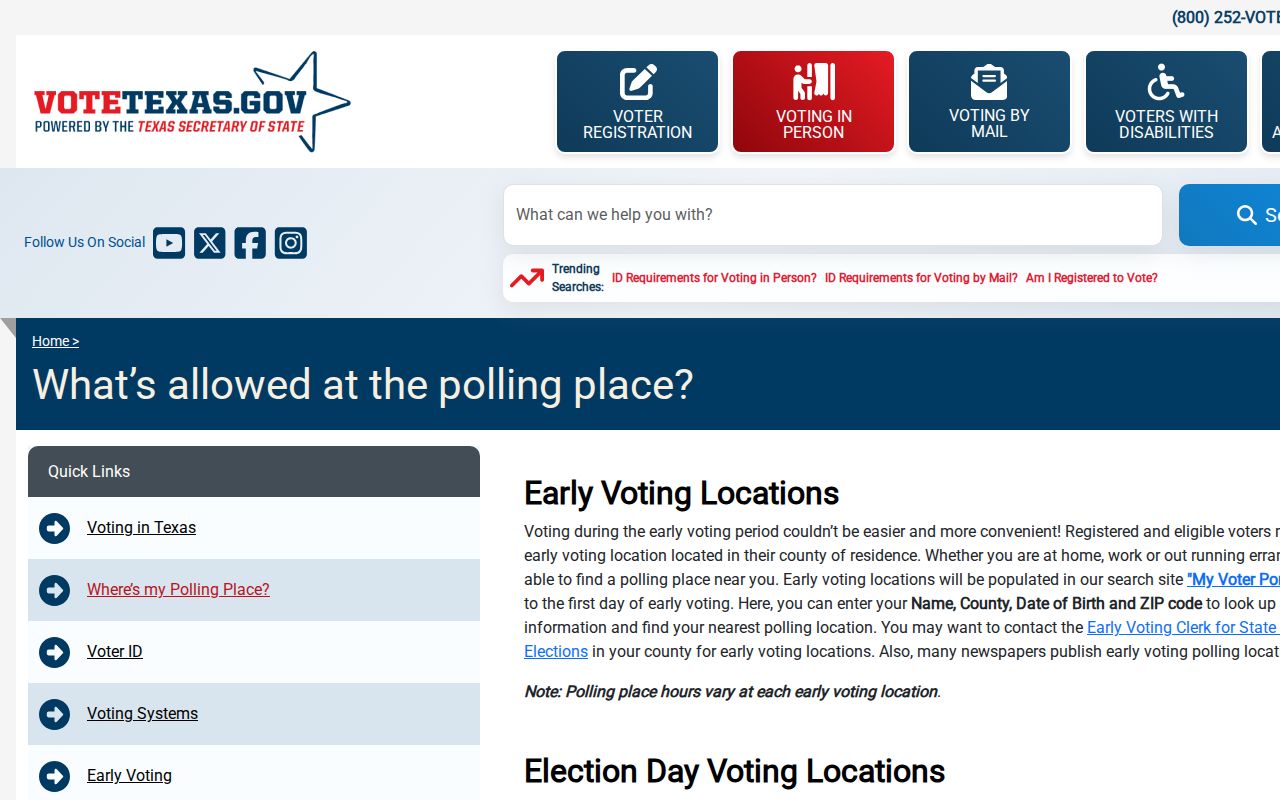
Use the result as one source to corroborate with a dated property, deed, directory, or newspaper record, not as a roster to republish.
Verify Cameron County Resident Matches
One name can point to several people. Normalize surname order, middle initials, married or former names, and Spanish-language variants before comparing a record. Then match roles and dates. A recorded transfer may name a grantor, grantee, trustee, or lender. A CAD result may show an appraisal owner label. A court result may show a plaintiff, defendant, respondent, petitioner, or attorney. Those identities should not be merged merely because a name is similar.
The Cameron County District Clerk links local case-search options, historic Kofile indexes, iDocket, and the statewide Re:SearchTX court search. If a cause number is not known, the District Clerk FAQ permits searching by name, case type, filing date, and date of birth, and states a $5 search fee. Preserve the cause number, court, party role, filing date, and disposition before requesting a copy. A docket entry is not the entire case file, and juvenile, sealed, expunged, family-violence, adoption, mental-health, and protected-address material can be unavailable or redacted.
The Re:SearchTX portal is one court-search route linked for Cameron County, although its live interface returned a 403 during inspection.
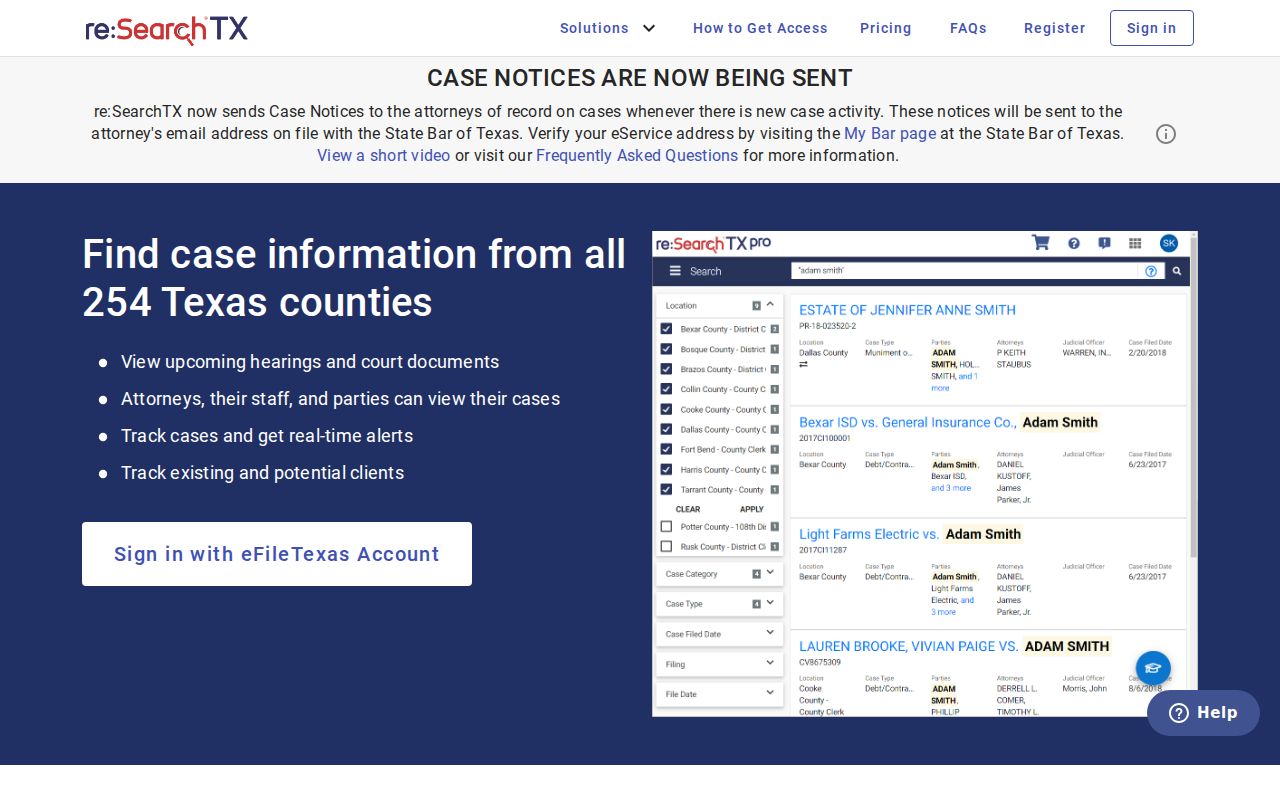
A cause number plus a clerk-confirmed disposition is stronger evidence than a name-only court result.
Current Cameron County Resident Directories
There is no single official book of current Cameron County residents. Current sources are narrower and must be read by their stated purpose. CAD is oriented to property appraisal. The clerk index is a party-to-recorded-document trail. VoteTexas is a registration and voting-status route subject to suppression. A court portal is a case-party route with access limits. Use the source that fits the question, then label what it actually shows.
| Source | Person signal | Custodian | Access route |
|---|---|---|---|
| CAD property roll | Owner label, parcel, situs information | Cameron Appraisal District | Public portal |
| Recorded official records | Grantor, grantee, deed or lien party | Cameron County Clerk | Current and historic indexes |
| Voter lookup | Registration and location clue | Texas and Cameron Elections | Official lookup, subject to rules |
| Court record | Named party and procedural event | District Clerk and courts | Portal or clerk request |
| Library and archive material | Dated household or event lead | TSLAC, BHA, libraries | Repository or archive access |
A commercial people-finder report can combine copied data from many places, but it may be outdated or wrongly matched. Official custodians identify their coverage and correction path. For a name-centered process, the Cameron County resident lookup has the focused verification sequence.
| Official source | Commercial compiled report |
|---|---|
| Shows a stated record type, custodian, and access rule. | May blend public and brokered material with uncertain timing. |
| Lets a researcher preserve a recording number, date, or repository citation. | Still needs confirmation from the source that holds the record. |
Cameron County Vital Record Access
Cameron County’s online vital-record ordering portal handles local birth, death, and marriage orders. The County Clerk’s local page lists certified birth copies at $23 online, certified death and marriage copies at $21, and additional certified copies at $4 where offered. It also separates the $5 nonrefundable processing or card charge and $1 VitalVerify charge from the record price, with USPS delivery shown as 10 to 14 business days. Check the live portal before ordering because the product, fee, and timing matter.
Recent vital records have eligibility controls. Texas identifies birth records as public after 75 years and death records as public after 25 years. Newer records may require a qualifying relationship, tangible interest, legal authority, or supporting documentation. A birth, death, marriage, or divorce event is not a current-residence finding. It can help establish a dated family-history or legal-event trail when used within the custodian’s rules.
The county vital-order page provides the online intake route for eligible Cameron County requests.
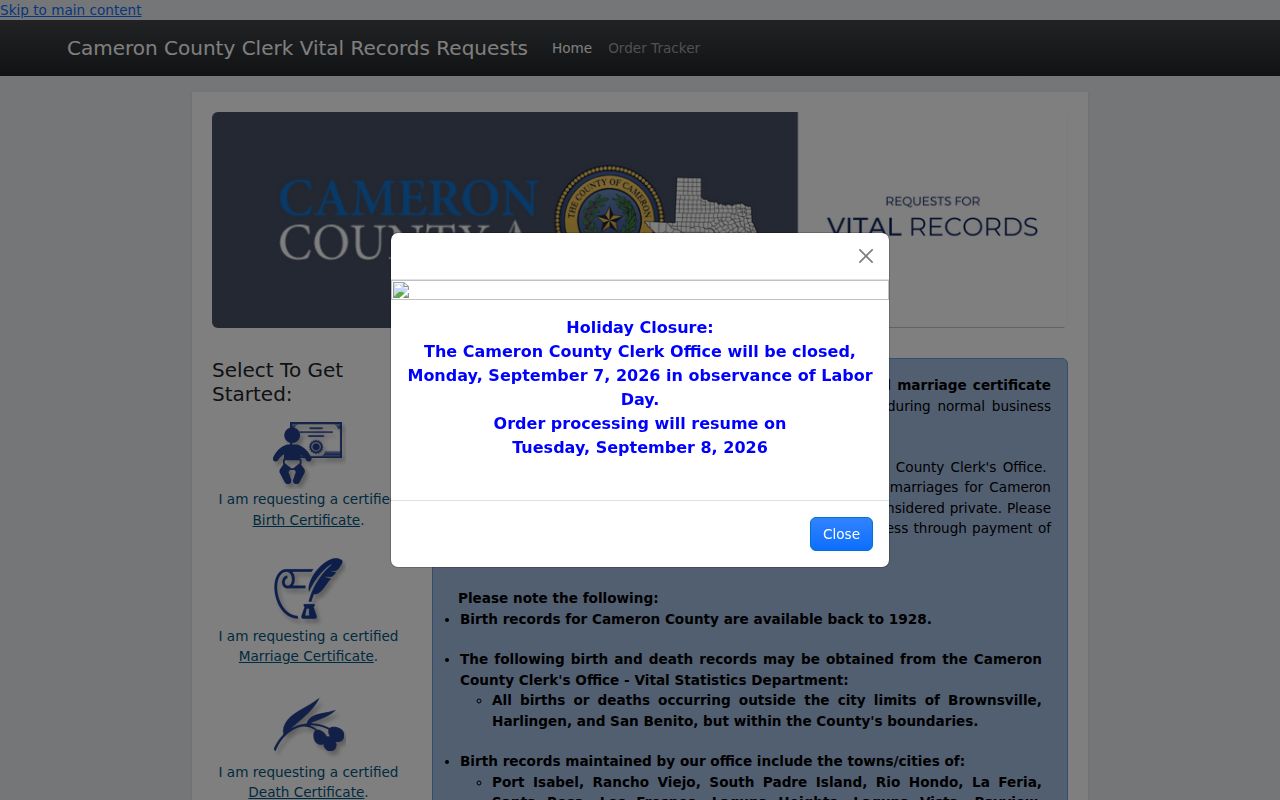
Order only the document that the question requires, and keep certificate details, identification fields, and parent information out of public notes.
Cameron County Privacy Protections
Texas Government Code Chapter 552, the Public Information Act, makes public information available for inspection or copying unless an exception applies. A request should identify existing records, the date range, the office, and a useful name, parcel, or case number. The governmental body may release the material, give a date for access, seek an Attorney General ruling, or state that it has no responsive record. Requesting an existing document is different from asking an office to create a new analysis.
Texas also protects particular information and people. Government Code §552.117 can apply to home addresses, phone numbers, emergency contacts, family information, and other fields for listed protected categories. Election confidentiality rules protect identifiers and certain addresses. The Texas Address Confidentiality Program gives qualifying participants a substitute mailing address and forwarding service. It is not a way to reverse-locate someone. Do not attempt to defeat a suppression, redaction, sealed record, or substitute address.
The Texas Address Confidentiality Program explains eligibility, substitute-address services, and current contact steps. Privacy limits are part of a sound search result: protected information should stay with the authorized custodian.
Historical Cameron County Resident Directories
For a past Cameron County residents directory entry, begin with the year and the city. The Texas State Library and Archives Commission lists Brownsville directories for 1966, 1968, 1970, 1971, 1973, 1978, a 1978 residential volume, and 1982. Its Harlingen holdings include 1965, 1966, 1969, 1971, 1973, and 1978. Earlier Wilmot directories add Brownsville years from 1938 through 1953 and Harlingen years including 1939, 1944, 1950, and 1956. The city name, publisher, page, and directory year should travel with every citation.
TSLAC does not perform complete directory searches by phone or send transcriptions by email. Its reading room, open shelves, closed-stack retrieval, database access, UNT resources, WorldCat, and local or academic libraries provide different access channels. Brownsville Historical Association has paper archives, photographs, land grants, maps, drawings, and newspapers. Its collection can be especially helpful where a directory entry needs a dated event or place confirmation. The historical shelf is explored in depth in the Cameron County city directory collections.
TSLAC’s Cameron County microfilm guide identifies local archival series that can support a directory lead. Repository coverage is dated and series-specific, so an absent year should be checked against the guide before it is treated as a gap.
Cameron County’s 1854 Deed Fire
Early records need a special caution. TSLAC reports that deed Volumes C and D, covering August 14, 1850 through February 6, 1851, were destroyed in an 1854 fire. That is a documented gap in a chain of title, not a failed modern search. Cameron County deed records otherwise begin in 1848, and later deeds, indexes, tax material, court minutes, probate, newspapers, and family papers may help reconstruct part of a missing interval.
The historic clerk index provides a separate route for deed index books from 1830 to 1968 and other historic index books from 1830 to 1957. Search names in their original or variant spellings, especially where Spanish, Mexican, Anglo, Indigenous, or later-transcribed forms differ. Preserve uncertainty rather than filling a gap with a guess.
The historic Cameron County clerk index offers year, party, and book, volume, and page controls for older research.
The current Cameron County official-records search is the source shown here and provides the modern index route.
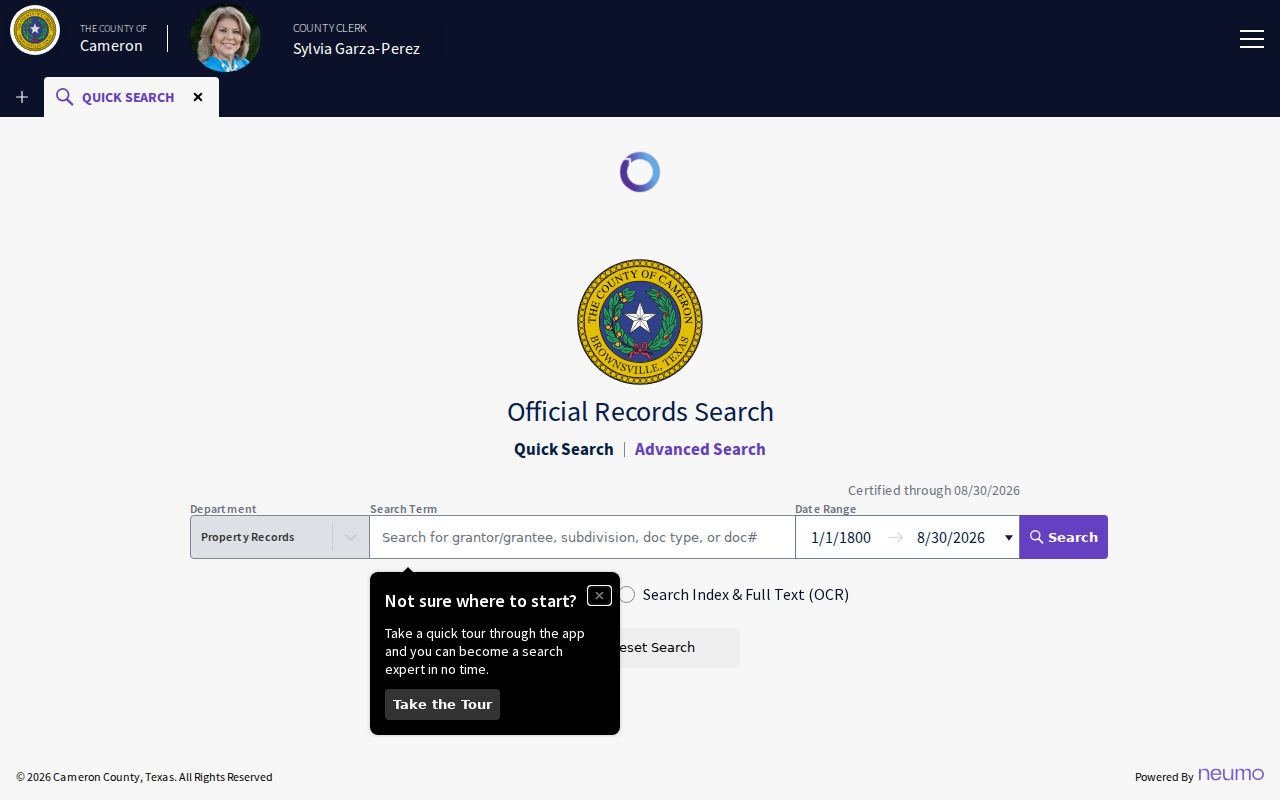
Current and historic indexes complement each other, but neither removes the need to identify the exact record series and dates.
Note: Record-history gaps deserve a clear citation, because a missing volume may explain why an otherwise careful Cameron County search stops.
Cameron County Archive Digitization
Some Cameron County resident evidence is becoming easier to find, but digitization is not the same as complete online coverage. County budget material for fiscal year 2024 to 2025 described official and deed records in a 20/20 system, digitized plat maps, Virtual Book Office index books, and continuing archival priorities. The Brownsville Historical Association reported in April 2025 that it had recovered 106 boxes of Chamber of Commerce records spanning roughly 80 years and that processing and digitization continue.
Those projects make a useful fallback chain when an online search ends: ask the repository about the series, box, reel, or index book; use its stated access channel; then cite the exact material found. BHA’s collection also includes historical newspapers and maps, which can connect a person, event, institution, or place without pretending that an archive mention establishes a present address.
Note: Cameron County’s online record systems improve access by series, so verify whether an index, image, or unprocessed collection actually covers the date needed.
Cameron County Public Safety Records
Custody and registration databases are status records, not a general Cameron County residents directory. The Cameron County Sheriff’s inmate page exists, but its live fields and coverage were not available in the static inspection. Texas Department of Criminal Justice, federal custody, and DPS resources each have their own limits. A name match can be wrong, a person may have transferred or been released, and a public-safety record does not establish that someone currently lives in the county.
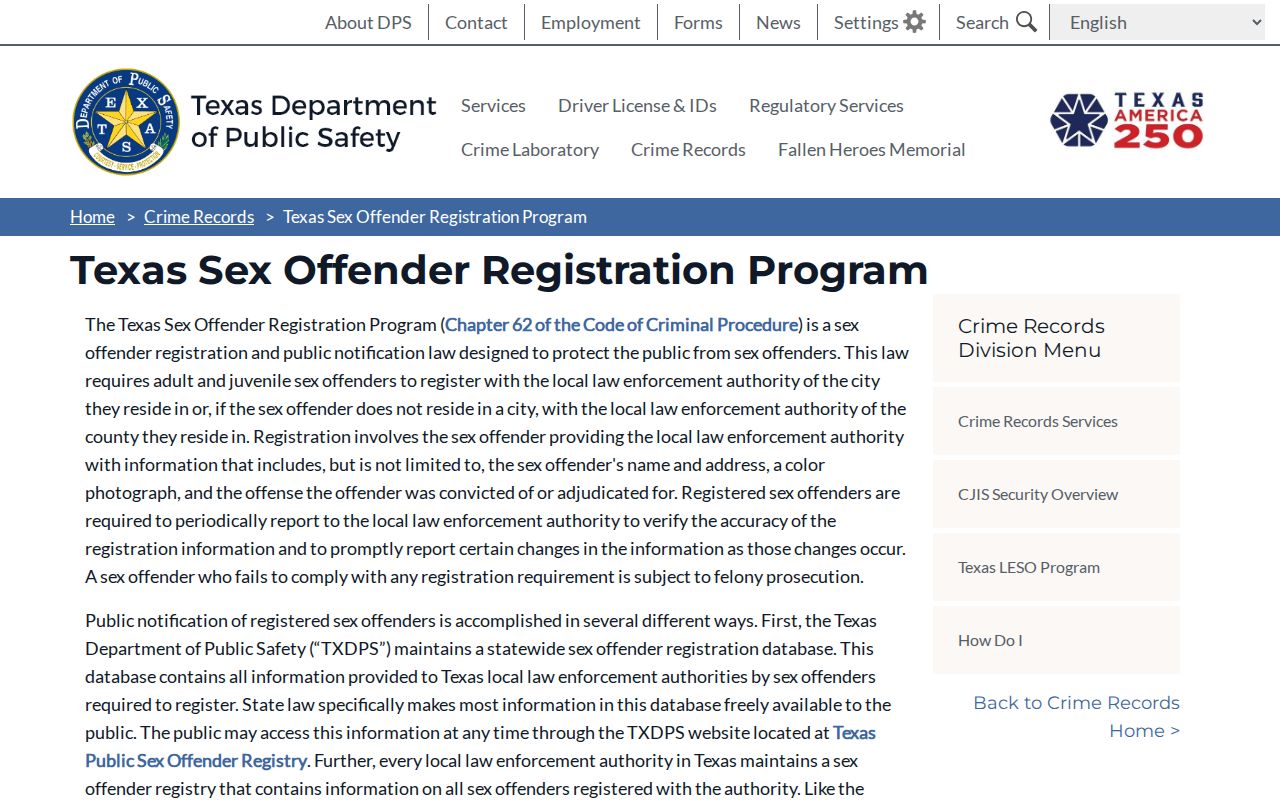
Texas DPS explains its sex-offender registration program and the limits on public fields. Use the official source and match location, name, and other authorized public details. Do not repeat protected fields, make a name-only accusation, or treat a search label as a conclusion about a person.
When a legal record is relevant, a cause number, disposition, and the responsible agency provide a safer verification path than an unsourced name match.